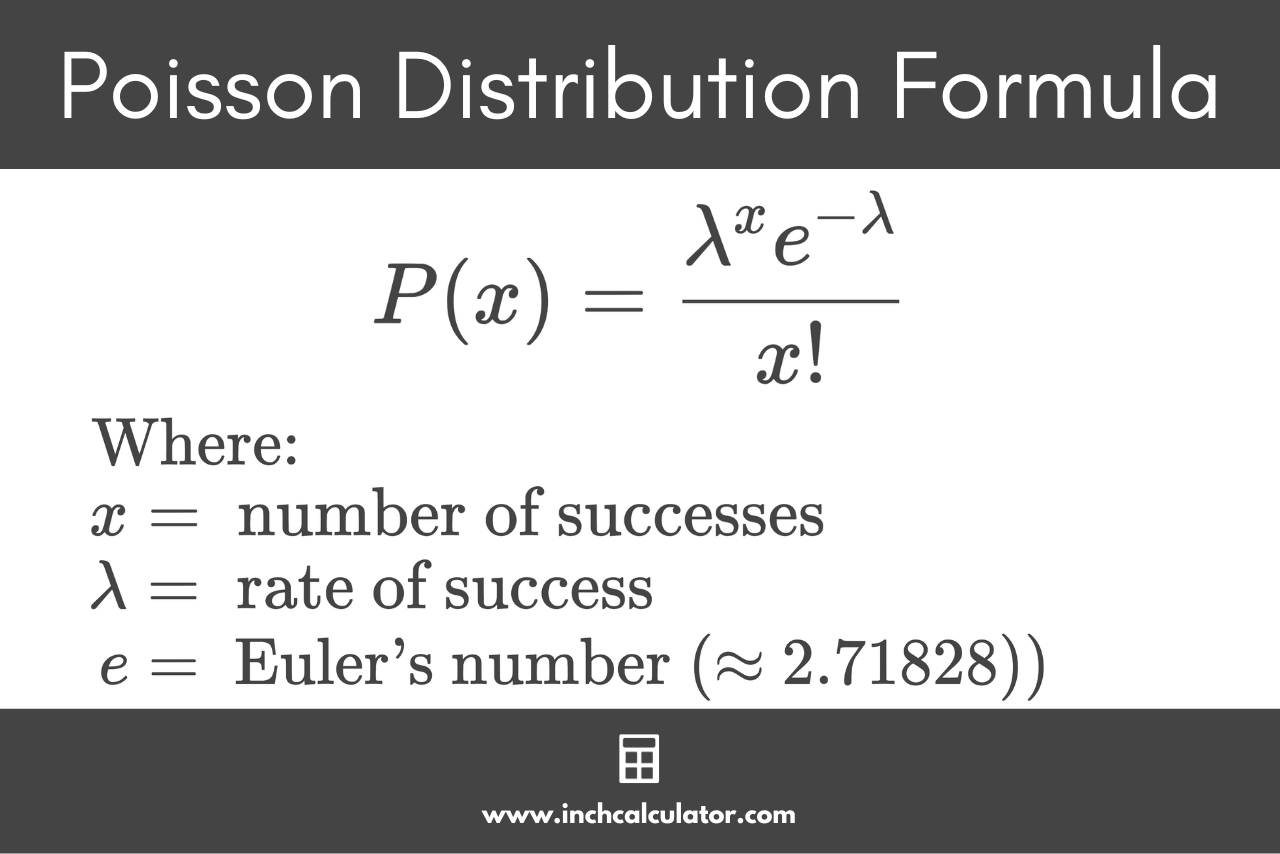
Poisson Distribution
2025-07-21 09:07
Status: #child
Tags: #mathematics #engineering #probability
Poisson Distribution
The Poisson distribution typically models the number of events occurring in a fixed interval of time or space, given that:
- The events occur independently of each other.
- The average rate of occurrence (denoted by 𝜆) is constant throughout the interval.
- The probability of more than one event happening in an infinitesimally small interval is negligible.
Consider a fixed time interval, say from 0 to T, and let the number of events that occur in this interval be k. The number of events is modeled by a random variable X.
- Let the rate of occurrence of events be 𝜆, meaning the expected number of events in the interval T is 𝜆T.
- We divide the interval T into n smaller sub-intervals of length delta(t) = T/n, where n is large and delta t is small.
For each sub-interval, we assume the following:
- The probability of exactly one event occurring in the sub-interval is proportional to delta t
- The probability of more than one event occurring in the sub-interval is negligible because delta t is small
- The number of events in each sub-interval is independent of others.
Thus, the probability P(one event in a sub-interval) is proportional to 𝜆Δt
Probability of no event occurring is 1-𝜆Δt
Now, for the entire interval T, the number of events X must follow a binomial distribution, where:
- We have n trials (each sub-interval)
- The probability of success (an event happening) in each trial is p1 = 𝜆Δt
- The total number of events k is the sum of successes in these n trials.
The binomial probability mass function (PMF) for observing k events is given by:
This essentially gives the probability of getting k successes/events out of n trials.
As n goes to infinity, we will have smaller time intervals. And we know that nΔt is T which is a fixed constant.
Under this limit, the binomial turns into the Poisson distribution!
Key Approximations
- As n approaches infinity, and as the interval gets smaller we can say that
- For large n and fixed k, we approximate: